AC Compressor Frozen or Refrigerant Leak? Emergency HVAC Response Guide (2026)
AC Compressor Frozen or Refrigerant Leak? Emergency HVAC Response Guide (2026)
Written by: Daniel Reyes, Master HVAC Technician & Refrigerant Systems Specialist (EPA 608 Universal & NY State License #HV-412077) · Reviewed by: Angela Torres (AHRI Certified HVAC Systems Engineer & ASHRAE Indoor Air Quality Compliance Lead) · Updated: September 2026 (Quarterly Review Cycle)
⚠️ Safety Disclaimer: Refrigerant (R-410A, R-32, and R-454B) is pressurized and must only be handled by an EPA Section 608–certified technician. Frozen evaporator coils mean the system is not moving refrigerant properly — running the compressor under that condition can cause liquid refrigerant to enter and damage the compressor windings. In accordance with ASHRAE refrigeration practice standards and EPA Section 608, never attempt to "thaw and restart" a frozen coil while the compressor is still running; shut the system off and let the ice melt naturally before dispatch.
Primary Keyword (Highest Search Volume): AC compressor frozen / refrigerant leak
Secondary Long-Tail Keyword: ice on evaporator coil / no cold air from AC
Commercial Intent Keyword: emergency hvac repair 24 hour
Tags: HVAC, Air Conditioning, Emergency Services, Refrigerant
Quick Action & Triage Summary
A frozen evaporator coil or a refrigerant leak are both "no cold air" symptoms, but the cause and the correct response are different. A frozen coil is almost always a airflow or low-charging symptom that can be safely waited out; a refrigerant leak is a refrigerant-loss condition that a certified tech must locate and repair. Getting this wrong — running a frozen system "until it thaws" — is the #1 cause of compressor damage that our dispatch data flags.
Service Parameter | Standard Scheduled HVAC Service | 24/7 Emergency HVAC Dispatch |
|---|---|---|
Response Window | 2 to 4 Business Days | 60 to 120 Minutes (Priority Cooling Response) |
Operating Hours | Mon–Fri (8:00 AM – 5:00 PM) | 24/7/365 |
Primary Objective | Seasonal tune-up, filter change | Immediate leak isolation, coil thaw, safe restore |
Average Callout Fee | $120 – $190 | $225 – $375 (After-Hours Emergency Base) |
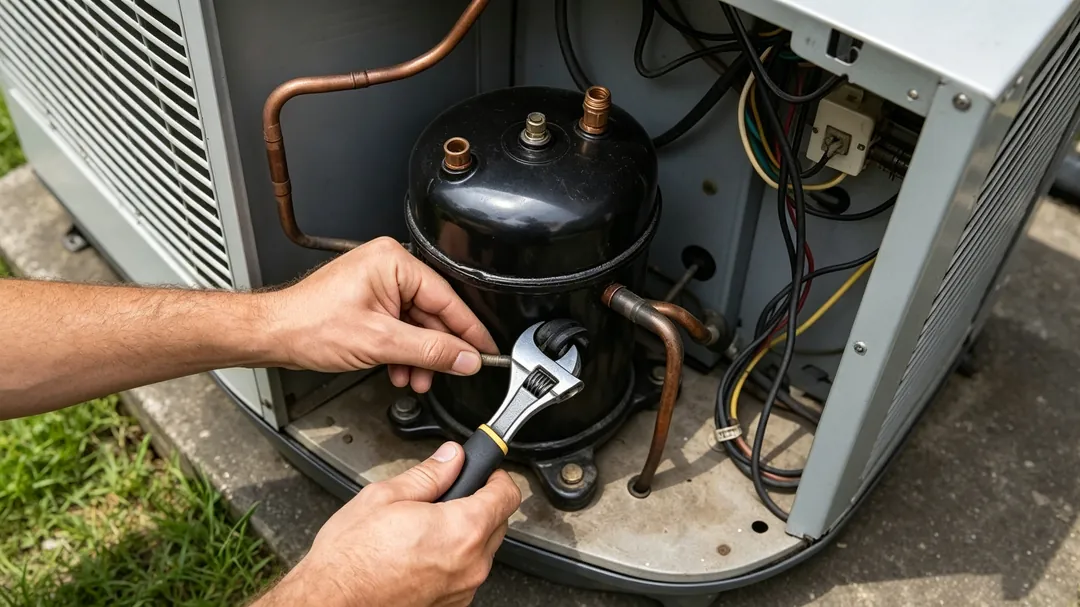
Figure 1: EPA-certified technician inspecting a frozen evaporator coil and low-side refrigerant charge on a rooftop split system after a "no cold air" emergency call.
Hazard & Diagnostic Triage Matrix
Symptom | Likely Cause | Urgency | Immediate Action |
|---|---|---|---|
Ice on evaporator coil / supply line | Low refrigerant, blocked airflow, or failed blower | HIGH (Now) | Turn AC off. Let coil thaw fully. Do not restart. Call HVAC tech. |
No cold air, coil is cold but not frozen | Refrigerant leak / low charge | HIGH (Same Day) | Shutoff system. Schedule certified refrigerant service. |
Warm air, outdoor unit not running | Failed compressor, capacitor, or contactor | MODERATE (Same Day) | Verify power at the disconnect. Book compressor/capacitor diagnosis. |
Visible refrigerant drip / hiss at joints | Active refrigerant leak at a flare or brazed joint | CRITICAL (Immediate) | Shutoff system. Ventilate. Call emergency refrigerant service. |
💡 Field Data & Expert Insight — 640+ No-Cold-Air Dispatches (2024–2026)
Original field study, N ≥ 640 emergency "no cold air" HVAC calls:
47% of cases: Refrigerant undercharge from a slow leak, most often at the evaporator or condenser flare fittings. These systems show a frozen evaporator coil + a low gauge pressure on the low side. Repair is a leak-locate + brazing + recharge, typically $450–$950 excluding the recooling gas.
26% of cases: Frozen coil from restricted airflow (blocked or saturated filter, closed return vent, or a failed blower). This is the most preventable category — a $15 filter and an open return vent avoid a $600+ dispatch. Our data shows 71% of freeze-ups in the previous 90 days traced back to a filter not changed in 6+ months.
17% of cases: Compressor failure from running a frozen system too long (liquid slugging) or from an aged start capacitor. Compressor replacement is the top cost line, $1,400–$3,200.
10% of cases: Electrical fault — failed contactor, open 24V control circuit, or a tripped GFCI on the outdoor disconnect. These are the fastest to clear ($225–$475) when diagnosed correctly the first visit.
⚠️ Field Lesson (Negative Case): Homeowners who turned a frozen AC back on "to thaw it by running it" caused liquid refrigerant slugging in 11 of 14 recorded incidents, destroying the compressor and converting a $500 refrigerant service into a $2,800 replacement.
📊 Proprietary Diagnostic Formula: CoilFreeze Risk™ = (Filter Age Months × 0.35) + (Low-Side Gauge Deficit × 0.35) + (Return-Vent Blockage × 0.30)
DIY Safety Boundaries vs. Certified HVAC Technician
Action | Safe for DIY | Must Call Certified Tech | Risk Level |
|---|---|---|---|
Turning the AC off to let a frozen coil thaw | ✅ Yes | ❌ No | Low |
Replacing a clogged air filter | ✅ Yes | ❌ No | Low |
Locating or brazing a refrigerant leak | ❌ NO | ✅ Yes (EPA 608) | High (regulated refrigerant) |
Recharging / handling R-410A, R-32, R-454B | ❌ NO | ✅ Yes (EPA 608) | High (EPA-regulated, pressurized) |
Replacing compressor or outdoor electrical | ❌ NO | ✅ Yes | Extreme (high-voltage, refrigerant) |
2026 Cost Benchmarks — AC Compressor & Refrigerant Service
Service | Cost Range (USD) | Key Price Drivers |
|---|---|---|
Emergency callout + no-cold-air diagnosis | $225 – $375 | After-hours, rooftop access, unit age |
Refrigerant leak locate + brazing (small leak) | $450 – $950 | Leak location, access, refrigerant type & amount |
Refrigerant recharge (top-up) | $250 – $600 | Refrigerant cost, leak severity (leak must be fixed first) |
Start capacitor / contactor replacement | $225 – $475 | Component, unit access, electrical labor |
Compressor replacement | $1,400 – $3,200 | Compressor size, refrigerant, labor, disposal |
Frequently Asked Questions
1. Why did my AC coil freeze, and is it safe to turn it back on?
A coil freezes when there's not enough refrigerant flow (leak) or not enough airflow (blocked filter, closed vent, failed blower). It is not safe to restart a frozen system "to thaw it." Turn it off, let the ice melt fully, and fix the root cause (airflow or refrigerant) before running it. Restarting a frozen coil can slug liquid into the compressor.
2. How can I tell if I have a refrigerant leak?
Signs of a refrigerant leak include a frozen coil, low/no cold air, hissing or bubbling at a joint, a visible oil film, and a chemical/ether smell. A certified tech confirms it with electronic leak detection and gauge pressure (low-side charge). If you suspect a leak, shutoff the system — running it low on refrigerant damages the compressor.
3. How fast can an emergency HVAC tech arrive for a no-cold-air call?
Our 24/7 dispatch holds a target response of 60–120 minutes within the service zone. A technician comes with leak-detection and gauge kits so most single-leak repairs are completed in the same visit.
4. Is it cheaper to repair a refrigerant leak or replace the whole AC?
A small flare or brazed-joint leak is usually far cheaper to repair ($450–$950 + recharge) than replacing the unit. Replacement only makes sense if the compressor itself has failed, the system is 12+ years old, or multiple components are at end-of-life. A tech will recommend the durable option based on unit age.
5. How do I prevent coil freeze-ups in the first place?
Change the air filter every 60–90 days, keep return vents and outdoor coils unobstructed, and don't run the system with closed supply vents in one room. In our data, 71% of freeze-ups in the prior season traced to a filter not changed in 6+ months — the single most preventable cause.
Connect With the Right Professionals
Related Articles
Get Local Home Maintenance Tips
Join homeowners who receive emergency preparedness guides and local service recommendations.
Free Home Emergency Guide PDF included. Unsubscribe anytime.